The Voynich Manuscript: The World’s Most Mysterious Book
Codes, history, language, theories, and unsolved questions
In this lesson, you will explore one of the most famous unsolved mysteries in history. You will practise advanced vocabulary, modal verbs of speculation, prepositions, mixed tenses, discussion skills, and written responses using a premium interactive lesson format.
Vocabulary
Click a card to flip it. Use Translate after choosing a language.
a handwritten book or document
The manuscript contains strange drawings and unknown writing.
Select a language.
a secret system of writing
Some people believe the text is a complicated cipher.
Select a language.
to understand or translate a secret code
No one has managed to decipher the whole text.
Select a language.
something very mysterious and difficult to understand
The book remains an enigma for historians.
Select a language.
the study of making and breaking codes
Cryptography experts have studied the manuscript for years.
Select a language.
a person who studies a subject seriously
Many scholars have suggested different theories.
Select a language.
connected with the Middle Ages
The book was probably created in the medieval period.
Select a language.
connected with plants
The manuscript contains many botanical drawings.
Select a language.
a picture or drawing in a book
Some illustrations show plants that do not seem to exist.
Select a language.
an idea that tries to explain something
One theory says the book is a medical text.
Select a language.
a trick that makes people believe something false
Some researchers think the manuscript could be a hoax.
Select a language.
real and not fake
Tests suggest the material is authentically old.
Select a language.
a person who studies languages
A linguist may look for patterns in the text.
Select a language.
a sign or image that represents an idea
The pages include strange symbols and diagrams.
Select a language.
a person who tries to solve secret codes
Famous codebreakers failed to read it.
Select a language.
an explanation of what something means
There are many competing interpretations of the drawings.
Select a language.
a careful search for facts
The investigation has continued for more than a century.
Select a language.
not solved or explained
The mystery is still unresolved.
Select a language.
complex and carefully designed
It may be a sophisticated code rather than random text.
Select a language.
a repeated form or structure
The writing seems to follow patterns similar to language.
Select a language.
Reading
Click highlighted vocabulary in the article for a definition, example, and translation.
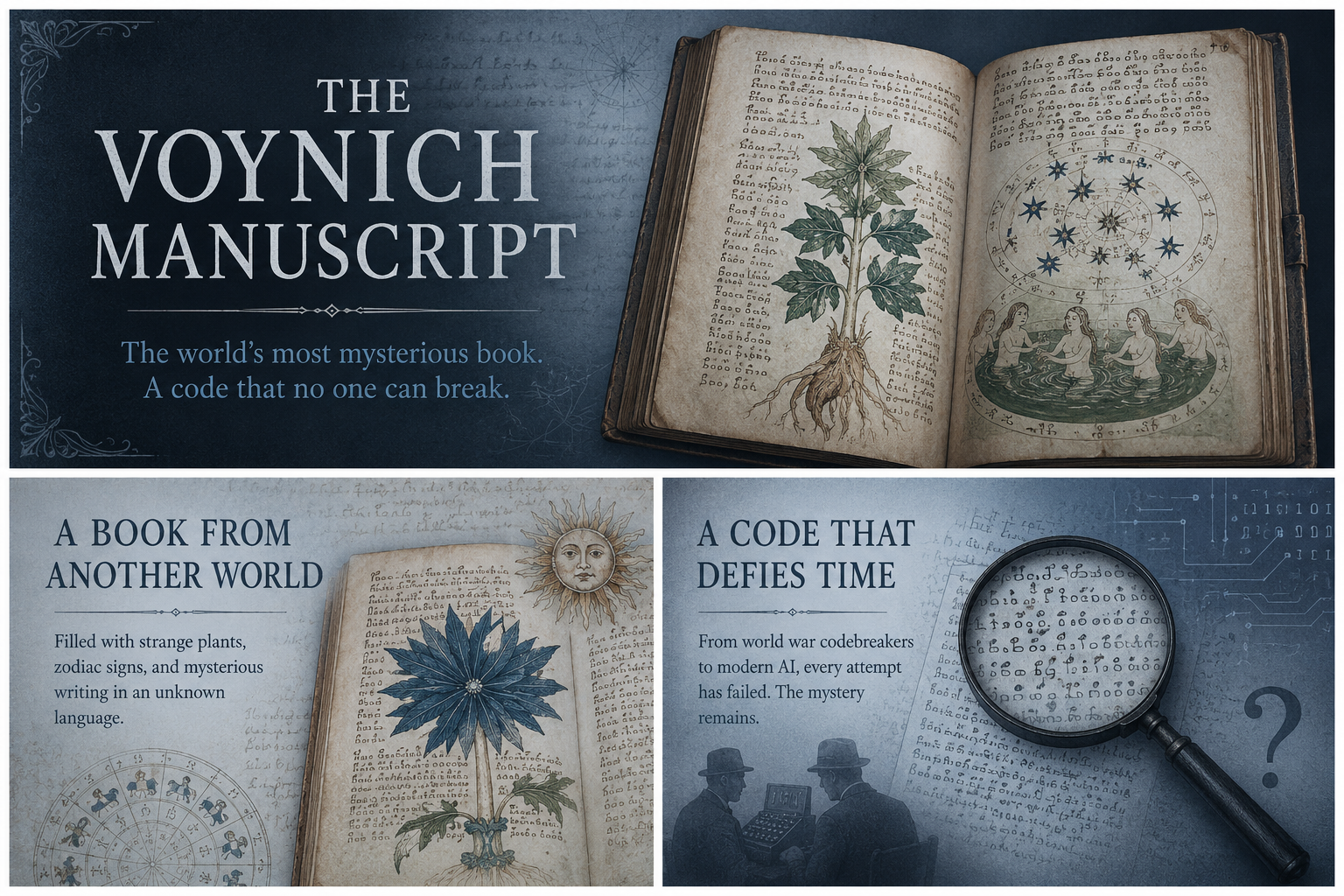
Imagine discovering a manuscript that looks important, beautifully illustrated, and carefully written — but cannot be read by anyone alive. That is the strange power of the Voynich Manuscript, a fifteenth-century book that still feels like an intellectual locked door.
The book is named after Wilfrid Voynich, a rare-book dealer who bought it in 1912. Inside are more than two hundred pages of unknown writing, strange symbols, circular diagrams, zodiac-like images, and detailed botanical drawings. Many plants in the pictures do not clearly match real species, which makes the book even harder to classify.
For over a century, historians, scientists, linguists, and cryptography experts have tried to decipher the text. Some believe it is a genuine language. Others argue that it is a cipher hiding medical, scientific, or spiritual knowledge. A more sceptical theory suggests that the book may be a clever hoax designed to impress wealthy collectors.
What makes the mystery more interesting is that the writing does not look completely random. Researchers have found repeated patterns that resemble features of real language. However, no one has produced a full, accepted interpretation of the text. It is meaningful enough to attract serious study, but strange enough to resist every explanation.
Even skilled codebreakers from the twentieth century failed to solve it. Modern technology has added new tools to the investigation, including computer analysis and artificial intelligence, but the results are still uncertain. Some algorithms suggest language-like structure; others suggest artificial construction.
The physical book appears to be authentic and medieval, but the message remains unresolved. Perhaps it is a lost language, a sophisticated code, or a historical prank. Whatever the truth is, the Voynich Manuscript remains an enigma because it sits exactly between knowledge and imagination.
Discussion Questions
Each question has its own writing space, example answer, and reset button.
Vocabulary Check
Mixed A–E answers. The options are intentionally close, so read carefully.
1. If a researcher tries to understand an unknown code, they try to...
2. A manuscript is best described as...
3. If something is unresolved, it is...
4. A hoax is...
5. A scholar would most likely...
6. Which word means complex and carefully designed?
7. An interpretation is...
8. Cryptography is connected with...
9. If a book is authentic, it is...
10. A repeated structure in text is a...
Gap Fill
Complete with vocabulary from the lesson.
Grammar Focus: Modal Verbs of Speculation
Use might, may, could, must, and can’t to talk about uncertainty and evidence.
1. The manuscript ______ be a real language, but nobody knows for sure.
2. It ______ be an ordinary book because no one can read it.
3. The author ______ have wanted to hide valuable information.
4. The drawings ______ represent medical or botanical knowledge.
5. The text ______ be meaningless, but the patterns make that difficult to prove.
Sentence Transformations
Rewrite each sentence without changing the meaning.
Prepositions
Complete the sentences with natural prepositions connected to research and mysteries.
Mixed Tenses
Choose the best tense for each sentence.
1. Researchers ______ the manuscript for more than one hundred years.
2. Wilfrid Voynich ______ the manuscript in 1912.
3. Today, scientists ______ computer tools to analyze the text.
4. By 2050, researchers ______ even more advanced methods.
5. While experts ______ the pages, they noticed unusual patterns.
Homework
Finish each sentence in your own words. Use the model answer only after trying.
Part 2: Vocabulary Gap Fill
Complete each sentence with the best lesson vocabulary word.
Part 3: Modal Speculation Practice
Rewrite or complete each sentence using a modal verb of speculation.